




Day 1 only – 3 April

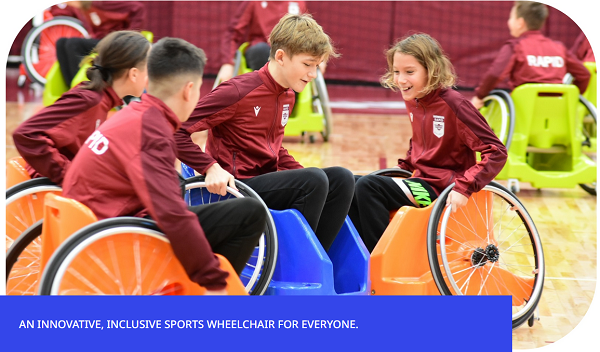
The French Embassy in Cyprus and the French Institute of Cyprus present KHEIRON Inclusive Innovations, an engaging, school-friendly project built around the Wallaby, an innovative and solidarity-based sports wheelchair invented by Wally Salvan to promote inclusion and living together through sport, bringing together girls and boys, able-bodied or disabled, in the same practice conditions.
100% made in France, eco-designed from high-density recycled plastic and recyclable up to ten times, the Wallaby combines strong scientific and technical interest with a powerful educational message by creating a shared sports experience that challenges the traditional separation between parasport and mainstream sport, building awareness through playful, supervised practice. Adaptable to multiple sports (e.g., football, basketball, handball, tennis, table tennis, badminton with accessories) and suited to an animated booth format, the proposal includes the presence of Wally Salvan with two chairs, projected video and brochures, and a guided practice area with a simple sports setup (such as a basketball hoop) for demonstrations and short participant trials.
Day 1 only – 3 April

CanSat is a simulation of a real satellite, equipped with all the systems that a satellite must have. Its size is equivalent to a can of soda (hence its name). The challenge for the students is to design the can in such way that all the subsystems found in a satellite, such as power supply, sensors, and communication system, should fit into this small space. CanSat satellites are then launched by a rocket to an altitude of approximately 1 km. Here, they detach from their carrier and begin their mission, which can be a scientific experiment or a technological demonstration. After a safe landing, the competitors analyze and present the data they have collected. The European Space Agency (ESA) announces the competition every year with the aim of giving students the opportunity to experience what it is like to participate in a real space project.
Our embassy has been supporting talented young Hungarians in presenting their work at sCYence Fair for years. In 2026, in cooperation with the Hungarian Astronautical Society, two teams of the CanSat competition were selected to join us at our stand. Each team will be represented by one member to introduce their innovation.
For the better understanding of their projects, we asked the students to summarize their work:
Team CAT represented by Csenge Szabó
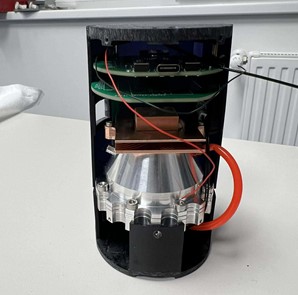 When people think about space exploration, they often imagine huge rockets and very expensive satellites. The CanSat competition shows that space technology can also be small and creative. A CanSat is a working mini-satellite that fits into the size of a soda can. Even though it is small, a CanSat works like a real satellite. It measures changes in its environment, sends data to a ground station by radio, makes decisions on its own during flight, and lands using (usually) a parachute. High School students design and build every part of the system, which makes CanSat an excellent way to learn about physics, electronics, programming, engineering and teamwork in a practical and exciting way.
The mini-satellite of the Hungarian CAT team focuses on protecting a payload while making observations. Inside the satellite, we built a small life-support cabin that controls temperature and air pressure, demonstrating how fragile systems can be kept safe in changing conditions. At the same time, an onboard camera observes cloud coverage during the descent, demonstrating how small satellites can help with weather and environmental studies. To make our measurements more reliable, important data is collected by multiple sensors, just like in real space missions.
With this project, our team wants to show that space technology is not only for astronauts and PhD scientists. It can also be a school project, hands-on, and inspiring for everyone.
Team ONION SAT represented by Tamás Pécsi
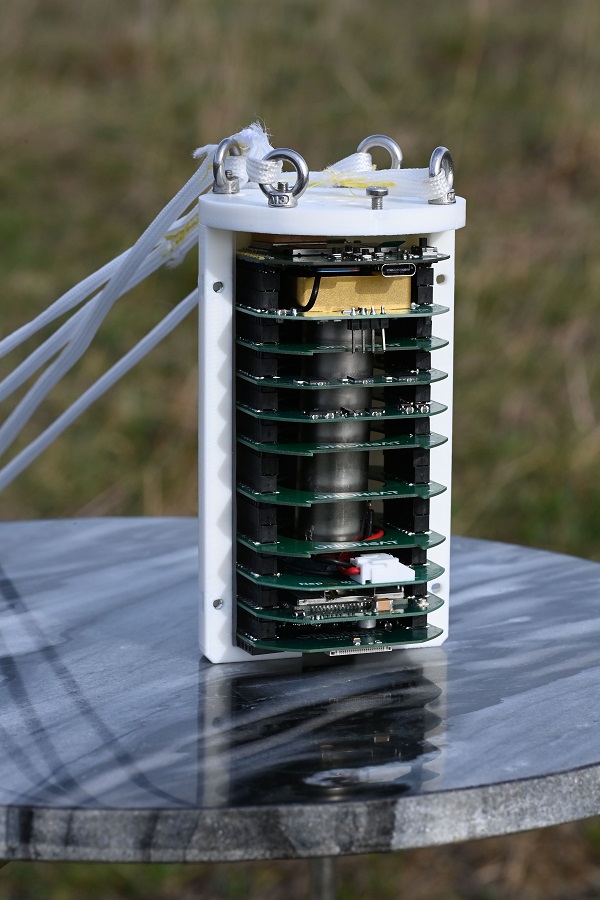 Our team was founded in 2023 with the aim of building a soda-can-sized satellite (CanSat), starting with zero engineering knowledge. We received a technology award at the 2024 national CanSat competition. Later on, we had the opportunity to develop an experiment for the next Hungarian satellite, called Hunity. Since its launch in November 2025, it has been working perfectly in outer space!
We focus on radiation experiments that push the boundaries of what’s possible in space. From designing our own fluid-based dosimeters to shrinking down muon tomography into the world’s smallest device, we basically develop radiation detectors smaller than a credit card (and satellites of course).
Neptune, our latest CanSat: This is our most complex satellite to date, featuring a custom-developed muon particle counter and ultra-precise environmental sensors. We designed it with a fully redundant system to ensure it always stays operational. With its high-quality camera, LTE (mobile data) connection, and built-in screen, it can do everything your smartphone can do—and quite a few things a smartphone can’t.
Day 1 only – 3 April


An interactive workshop stand enabling visitors to learn about the achievements of outstanding Polish scientists. We will take a closer look at Polish female scientists whose discoveries have changed the world, such as Maria Skłodowska Curie.
Participants can enjoy a range of activities from different fields of science. Most take place under the supervision of an animator, although there is also a space for exploration on one’s own.
The workshops combine science with fun, encouraging experimentation, exploration and self-discovery. Activities based on the STEM approach, integrating science, technology, engineering and mathematics, develop the participants’ logical thinking and creativity as well as analytical and manual skills. In addition, they will allow participants to learn about the achievements of Polish science, which have influenced the development of the world.
Day 1 only – 3 April


Office of Innovation (OOI) helps ensure solutions and responses are designed with and for them. OOI works at the intersection of technology and children’s rights, equipping young people as creators, problem-solvers, and architects of a safe, secure, and equitable future. Across regions, UNICEF has demonstrated that when youth are given the tools, trust, and skills to engage with science and technology, they do not merely consume innovation. They help shape it. This year the Embassy of Sweden and UNICEF collaborated by presenting an engaging and informative experience that brings these ideas to life for primary and secondary school-aged learners, while offering educators practical, classroom-ready resources. To inspire, equip, and empower young people by showcasing how science, technology, and creativity can be applied to real-world challenges, particularly climate action, environmental stewardship, and digital literacy, through an accessible exhibition format.
“What Would You Do?” is a short, gamified, self-guided video that uses existing UNICEF-produced content to show how science, technology, and creativity empower children to address real-world challenges. Visitors watch a fast-paced, trivia-style video and respond to simple multiple-choice questions. By making choices and seeing the outcome, young visitors discover how peers like them are becoming changemakers and are prompted to explore these initiatives further.