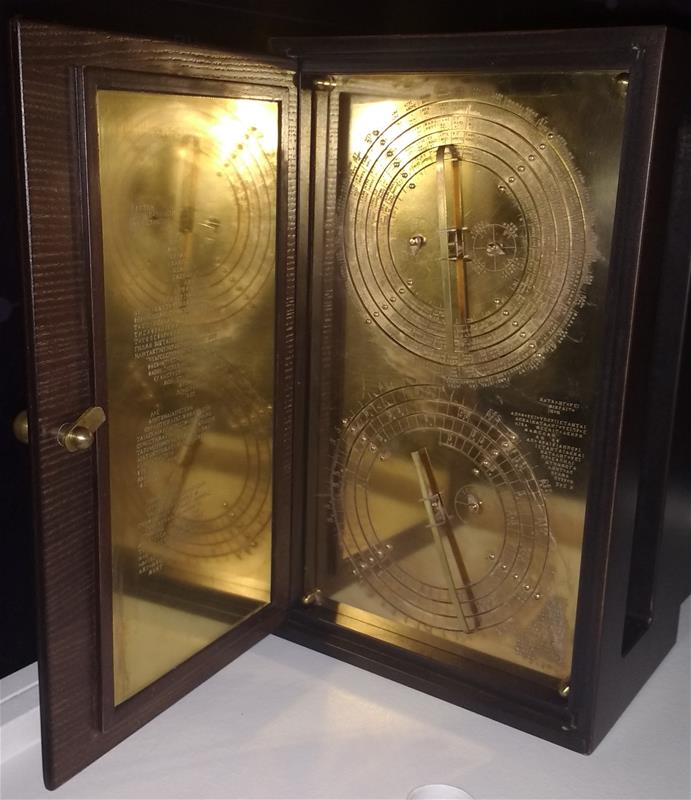
The Antikythera Mechanism was an analog computer of astonishing technology — the first of its kind in world history. It was constructed more than 2,000 years ago (2nd century BCE) and was used for the precise calculation of the positions of the Sun, the Moon, and possibly the planets in the sky.
It calculated the phases of the Moon, predicted solar and lunar eclipses, and determined the dates of major ancient Panhellenic games (Olympic, Pythian, Nemean, and Isthmian Games).
Both its front and back surfaces were covered with bronze plates bearing calendrical and astronomical scales and pointers. Astronomical, geographical, and technical instructions for its use were inscribed not only on two protective plates but also on the corroded internal components of the mechanism.
It is an archaeological find of exceptional importance for our understanding of ancient technology and its development. No similar ancient mechanism has been discovered to this day. The Antikythera Mechanism is rightly considered as significant for the evolution of Technology as the Acropolis of Athens is for the evolution of Architecture.
Construction of a Full-Scale Replica of the Antikythera Mechanism
The most recent model of the Mechanism, incorporating all research findings to date, has been constructed at the Aristotle University of Thessaloniki by the Antikythera Mechanism Research Team under the supervision of Associate Professor Kyriakos Efstathiou of the Department of Mechanical Engineering.
This model is built at full scale (1:1), with an almost identical assembly method and the same construction materials as the original. For the engraving of its plates, a special typeface was created and used to simulate the lettering style of the original Antikythera Mechanism inscriptions.
The replica contains 39 interlocking gears.
Antikythera Mechanism Research Team – Aristotle University of Thessaloniki
- Ioannis Seiradakis, Professor, Department of Physics
- Kyriakos Efstathiou, Associate Professor, Department of Mechanical Engineering
- Magdalini Anastasiou, PhD Candidate, Department of Physics
- Marianna Efstathiou, Mechanical Engineer, Department of Mechanical Engineering
- Alexandros Basiakoulis, Mechanical Engineer, Department of Mechanical Engineering
You can find more information about the exhibition here.
The guided tour will take place on 3 and 4 April at 11:00 and will last 45 minutes.